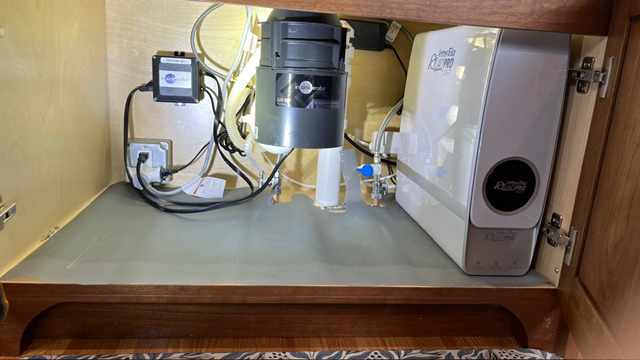
An installed reverse osmosis drinking water system from Aquanology typically costs $950 to $2,000, and a whole-house RO system typically costs $10,000 to $18,000. Your exact price depends on your installation requirements, the equipment available, and the options you choose. The biggest factor is usually your water: well or city supply, how hard it is, and what needs to be removed. After installation, our yearly service charge is $85, plus filters and supplies.
You’ll see RO systems online for a few hundred dollars, and some local companies advertise flat price ranges. Those numbers aren’t wrong, but they usually describe the box, not a system designed, installed, and maintained for your specific water. Below, we break down what each type of system costs installed, what’s included, and what you’ll spend to keep it running, so you can compare quotes on equal terms.
Reverse Osmosis System Cost at a Glance
Installed prices from Aquanology, including the system and standard installation:
| System type | Installed price | Daily output | Install time | Best for |
|---|---|---|---|---|
| Standard under-sink RO (drinking water, with storage tank) | $950–$1,200 | About 75 GPD | 1–3 hours | Drinking and cooking water at the kitchen sink |
| Interflo QuadPro SST tankless RO (drinking water) | $1,700–$2,000 | 730 GPD | 1–3 hours | Our most popular system: faster flow and much higher output, with no storage tank |
| Whole-house RO | $10,000–$18,000 | 1,500 GPD | 12–20 hours | Severe water problems treated at every tap |
Prices vary depending on installation requirements, available equipment, and the options you choose. These are typical ranges, not quotes. A free water test and consultation is how we confirm which system fits your home and what it will cost.
Both the standard system and the QuadPro are drinking water systems. The QuadPro’s high output leads some people to assume it treats the whole house, but it’s designed to supply a dedicated drinking water tap. If you want treated water at every faucet, a whole-house RO system is the right comparison.
What’s Included in the Price
A standard drinking water RO installation from Aquanology includes:
- A free water test and system recommendation
- The RO unit, storage tank (standard system), and dedicated drinking water faucet
- Drilling the faucet hole, including in stone or quartz countertops
- Connection to the cold water line and drain
- Leak and pressure testing, and system startup
- A walkthrough of how to use and maintain the system
Optional upgrades, such as a remineralization stage, can add to the price; we’ll go over any options during your consultation. Whole-house systems are custom-designed around your water, so their scope is set during the consultation.
A drinking water installation, standard or QuadPro, typically takes 1 to 3 hours. A whole-house RO system takes about 12 to 20 hours to install.
What Affects the Cost of an RO System
Two homes can buy the same RO unit and pay very different amounts. These are the factors that move the price:
- Your water chemistry. This is the biggest variable. Hardness, iron, sediment, chlorine, and high total dissolved solids (TDS) can all shorten membrane life, so they may need pre-treatment before the RO system. A water test tells us exactly what’s needed.
- Well water vs. city water. Many private wells in Wayne County and the Finger Lakes carry hardness, iron, sulfur, or sediment that city water doesn’t. City water usually means a simpler setup, though chlorine or chloramine still needs a carbon pre-filter to protect the membrane.
- System type and capacity. A household that drinks and cooks with a few gallons a day needs a different system than one that wants purified water on demand.
- Installation conditions. Cabinet space, drain access, and how far the system sits from the faucet all affect labor.
- Options and upgrades. Features like remineralization add cost, and they’re only worth it in the right situation.
Why a Flat “Box Price” Doesn’t Tell You What You’ll Pay
If you buy a drinking water RO system online, you can spend anywhere from about $150 to $600. Online cost guides and some local websites quote similar flat ranges. Those figures usually describe the equipment alone, sized for average city water and installed by the homeowner.
That approach works for some homes. It breaks down when the water isn’t average, and in Upstate New York it often isn’t. An RO membrane fed hard or iron-heavy well water without the right pre-treatment can foul long before its rated life, and the money saved on the box goes into early replacements. A system that’s undersized for the household runs constantly and still runs out.
An installed price from Aquanology reflects a system designed around your water test, including:
- A water test before any recommendation. We size the system to what’s actually in your water, not to an average.
- Professional installation. Correct connections, drain setup, pressure testing, and startup, done by the team that will service the system.
- Local service. If something needs attention, you call our team, not a manufacturer’s support line.
Compared with other water treatment specialists, our pricing tends to fall on the lower end. It’s also why our recommendation is sometimes a smaller system than you expected, or no RO at all. More on that below.
Ongoing Costs: Filters, Membranes, and Service
The purchase price is only part of what an RO system costs. Here’s what to plan for after installation:
| Item | How often | Cost and notes |
|---|---|---|
| Yearly service visit | Once a year | $85, which covers one hour of service time; filters and supplies are extra |
| Sediment and carbon pre-filters | Every 6–12 months | Protect the membrane and keep water tasting good |
| RO membrane | Varies with water quality and use | Replace when output drops, taste changes, or TDS readings rise |
| Extra water use | Ongoing | Older basic systems can send 3 to 10 gallons to the drain per gallon produced; modern tankless designs are far more efficient |
Skipping pre-filter changes is the most expensive way to save money on an RO system. Sediment can clog the membrane and chlorine can permanently damage it, and a membrane often costs more to replace than the filters that protect it.
RO vs. Bottled Water: The Long-Term Cost
For many households, the real comparison isn’t one RO system against another, it’s RO against what they already spend on bottled water. A family that buys bottled water every week can spend several hundred dollars a year on it. In an earlier article, we estimated savings of up to $500 per year for a typical household that switches to an RO system.
A simple way to run your own numbers:
- Add up what your household spends on bottled water in a typical month and multiply by 12.
- Subtract the yearly service and filter cost for the system you’re considering.
- Divide the installed price by what’s left. That’s roughly how many years the system takes to pay for itself.
Beyond the money, an RO system means no hauling cases home, no plastic to recycle, and purified water on tap whenever you want it.
Do You Actually Need Reverse Osmosis?
Not always, and we’ll tell you if you don’t. RO is the right choice when your water contains dissolved contaminants that ordinary filters can’t remove, or when you want the highest-quality drinking water available. In other situations, a simpler option does the job for less:
- If your concern is chlorine taste or odor on city water, a carbon filter may be all you need.
- If your problem is hardness, scale, or staining, a water softener addresses that throughout the house. Some homeowners then add a small RO system at the kitchen sink for drinking water, especially if they don’t like the taste of softened water.
- If you’re on a well, bacteria, iron, and sediment usually need to be addressed first. RO may be part of the answer, but rarely the whole answer.
- RO is usually worth it when testing shows lead, nitrates, arsenic, fluoride, or high TDS, or when you want bottled-water quality at the tap.
If you’re on city water in Lyons, Newark, or another town we serve, the same rule applies: test first, then decide. Your water provider’s annual water quality report is a good starting point, and our free water test fills in the details.
How Reverse Osmosis Works
Reverse osmosis pushes water through a semi-permeable membrane, a very tight filter that lets water molecules through while holding back most minerals, metals, and chemical contaminants. The membrane constantly flushes what it rejects to the drain, which keeps it from plugging.
A typical drinking water RO system has several stages:
- Sediment pre-filter, which removes particles that would clog the membrane.
- Carbon pre-filter, which removes chlorine (harmful to the membrane) and improves taste and odor.
- RO membrane, where most dissolved contaminants are removed.
- Storage tank, which holds purified water so you can draw a glass or a pot full at a time. Tankless systems like the QuadPro skip the tank and purify on demand.
- Post-filter, often carbon, which polishes the taste before the water reaches the faucet. Some systems add remineralization or UV here.
Every RO system also needs a drain connection, because the membrane is constantly flushing away what it removes.
What RO removes
Depending on your water and the system’s design, RO reduces sodium, nitrates, sulfates, fluoride, arsenic pentavalent, lead and other heavy metals, certain volatile organic compounds (VOCs), certain PFAS compounds, and total dissolved solids, typically up to 95% of dissolved contaminants. When paired with UV, an RO system also provides a barrier against bacteria and viruses.
What your RO system needs to target depends on your source. Private wells can carry naturally occurring sulfates, nitrates, arsenic, or extra sodium from a water softener. City water is more likely to carry chlorine byproducts, lead from older service lines, or added fluoride.
For the highest assurance, look for systems certified to NSF/ANSI Standard 58 or carrying a WQA Gold Seal; certified systems document their tested reduction rates. The QuadPro is a third-party certified system.
Fluoride
Fluoride occurs naturally in some ground and surface water, and many public water systems, including Rochester’s, add it for dental health. The EPA’s maximum contaminant level is 4 mg/L, and the U.S. Department of Health and Human Services recommends 0.7 mg/L for public water systems. Whether to remove it is a personal decision; if you have health questions, we recommend asking your doctor or pediatrician.
Standard carbon, pitcher, and refrigerator filters remove little fluoride. RO typically removes 90% to 95% of it, which makes it one of the most effective home options.
Is RO Water Healthy to Drink?
Aquanology doesn’t make health claims beyond those set by the EPA, so here are the two concerns we hear most often and how we see them.
Lower pH. RO water is slightly acidic, usually in the upper 5s to low 6s, similar to rainwater. Coffee, tomato juice, and orange juice are all more acidic, and your body regulates its own pH tightly regardless of what you drink. A remineralization stage can raise the pH if you prefer.
Fewer minerals. RO removes most minerals along with contaminants. Most of the minerals your body needs come from food, and many health professionals view drinking water mainly as a source of hydration. If you want minerals added back, a remineralization stage does that.
The bigger health factor is simple: people drink more water when it tastes good and they trust it.
Whole-House Reverse Osmosis System Cost
A whole-house RO system typically costs $10,000 to $18,000 installed, produces about 1,500 gallons per day, and takes 12 to 20 hours to install. The price gap with a drinking water system comes from scope. A whole-house system treats every gallon entering your home, so the RO membrane sits at the center of a full treatment train: pre-filtration, anti-scale protection, pH neutralizing, a storage tank with a re-pressurizing pump, and final polishing such as UV disinfection. For a closer look at how each stage works, its pros and cons, and the situations where it makes sense, read our guide, Whole House RO Systems: What Homeowners Need to Know.
What Drives Whole-House RO Cost
Pre-treatment is the biggest variable. Water with high iron, hardness, or sulfur needs more equipment ahead of the membrane than water that’s merely high in dissolved solids. Household size sets the system’s capacity and tank size. Installation space matters too, since whole-house RO needs a much larger footprint than a typical softener setup.
Operating Costs to Plan For
Whole-house RO costs more to run than a softener. It sends more water to the drain, and its pumps use more electricity. It also needs regular filter changes, antiscalant refills, and a yearly UV lamp replacement. Our yearly service charge is $85, which covers one hour of service time, with filters and supplies extra. We can also train you to handle the routine checks yourself. On the other side of the ledger, homes with extremely hard water can cut their softener salt use dramatically.
Is Whole-House RO Worth the Cost?
Whole-house RO is worth the investment when it’s the only method that solves your water problem. Examples include high TDS, sulfates, nitrates, or chlorides throughout the house, which a softener can’t remove. For most homes, a softener paired with a drinking water RO system at the kitchen sink delivers what they need at a fraction of the cost. A water test tells you which camp you’re in.
Financing and Payment Options
If a system fits your needs but not your budget right now, financing options are available through third-party finance companies we work with. Rates, terms, and monthly payments are subject to credit approval. Ask about financing during your free consultation, and we’ll walk you through your options.
Get an Accurate Price for Your Home
The fastest way to know what a reverse osmosis system will cost you is a water test. We’ll test your water, look at your space, and give you an honest recommendation, including when a simpler or less expensive option will do the job. Aquanology has installed and maintained RO systems in Upstate New York for more than 12 years, and we service what we sell.
Schedule your free water test and consultation, or call our Finger Lakes office at (315) 856-0483 or our Mohawk Valley office at (518) 906-4567. When you call during business hours, you’ll talk to an actual water specialist, not an answering machine, and we typically return calls within an hour. Online requests get a response within one business day.
Reverse Osmosis Cost FAQ
How much does a reverse osmosis system cost installed?
An installed drinking water RO system from Aquanology typically costs $950 to $1,200 for a standard under-sink system and $1,700 to $2,000 for the QuadPro tankless system. Whole-house RO systems typically cost $10,000 to $18,000. Prices vary depending on installation requirements, available equipment, and the options you choose. A free water test gives you an exact quote.
Is the QuadPro a whole-house system?
No. The QuadPro is a drinking water system. Its 730 gallons-per-day output is far higher than a standard under-sink system’s, which leads some people to assume it serves the whole house, but it’s designed to supply a dedicated drinking water tap. For treated water at every faucet, you’d need a whole-house RO system.
Why is a whole-house RO system so much more expensive than an under-sink system?
An under-sink system treats water at one tap and installs in a few hours. A whole-house system treats every gallon entering the home, so it needs pre-treatment, a large storage tank, a re-pressurizing pump, and post-treatment, all sized to your water and household.
How long does installation take?
Most drinking water RO installations take 1 to 3 hours. Whole-house systems take about 12 to 20 hours.
What does it cost to maintain an RO system?
Our yearly service charge is $85, which covers one hour of service time, with filters and supplies extra. Pre-filters are typically changed every 6 to 12 months.
How long does an RO membrane last?
It depends on your water quality and how much water you use. Hard or iron-heavy water without proper pre-treatment shortens membrane life. A drop in output, a change in taste, or rising TDS readings are signs it’s time for a replacement.
Do you offer financing?
Yes. Financing options are available through third-party finance companies we work with, subject to credit approval. Ask about them during your free consultation.
Can I install an RO system myself?
Many homeowners can install a basic under-sink system. Professional installation makes sure the system is sized for your water, connected correctly, pressure-tested, and started up properly. Whole-house RO should always be professionally designed and installed.
Do I really need reverse osmosis, or will a simpler filter do?
It depends on your water. If your main concern is chlorine taste, a carbon filter may be enough. If testing shows lead, nitrates, arsenic, fluoride, or high TDS, RO is usually the better choice. We’ll tell you which one your water needs.
Does reverse osmosis waste water? Will my water bill go up?
Yes, all RO systems send some water to the drain to keep the membrane clean and flush contaminants, but the amount of waste water varies widely. Older basic systems can waste 3 to 10 gallons for every gallon of purified water. Modern tankless systems are far more efficient, producing up to 3 gallons of purified water for every gallon sent to the drain. If you’re on metered city water or a low-yield well, ask about a system’s product-to-waste ratio before you buy.
Does reverse osmosis remove fluoride?
Yes. RO typically removes 90% to 95% of fluoride, which standard carbon, pitcher, and refrigerator filters largely don’t.
Will RO remove lead and nitrates?
Yes. RO is one of the most effective residential treatments for lead, nitrates, arsenic pentavalent, and salts.
Does reverse osmosis remove PFAS?
RO is among the most effective home treatments for reducing PFAS, the u0022forever chemicalsu0022 increasingly found in New York water supplies, although it is important to check for system certifications, as some systems will handle it better than others. A water test can tell you whether PFAS is a concern in your water.
Is whole-house RO a good fit for well water?
Often, yes, when it’s properly designed with the right pre-treatment and UV disinfection. Wells with high TDS, sulfates, or salt are where whole-house RO tends to make the most sense.
How much space does a whole-house RO system need?
Considerably more than a softener, because of the storage tank, pump, and multiple treatment stages. We plan the layout during the consultation.
Do you service RO systems you didn’t install?
In most cases, yes. We service most common brands. A few brands use proprietary parts that are harder to source, so let us know what you have when you call.
Is the water test free?
Yes. Aquanology offers free onsite water tests and consultations. Sometimes we recommend additional lab testing for more contaminants in specific challenging water quality scenarios, which do have a cost. However, we are sure to communicate costs of lab testing for your approval, if we suspect it is necessary.